---
title: "Customily alternative for AI-personalized Shopify products"
description: "See how Customily compares with Personalize.design for AI-generated artwork, live product rendering, layers, fulfillment, pricing, and Shopify POD setup."
canonical: "https://personalize.design/alternatives/customily-alternative/"
markdown: "https://personalize.design/alternatives/customily-alternative.md"
language: "en"
page_type: "resource"
section: "Alternatives"
format: "Product alternative"
published: "2026-07-31"
modified: "2026-08-13"
verified: "2026-08-13"
author: "Personalize.design editorial team"
reviewed_by: "Personalize.design product team"
indexing: "index"
tags:
- "Customily alternative"
- "Shopify personalization"
- "print on demand"
- "AI personalization"
- "Printify"
---
# Customily alternative for AI-personalized Shopify products
> See how Customily compares with Personalize.design for AI-generated artwork, live product rendering, layers, fulfillment, pricing, and Shopify POD setup.
## TL;DR
Personalize.design is built for Shopify POD merchants who want to stand out from generic POD products, start with one idea, and launch quickly. Use one reusable AI Blueprint to test a product, let shoppers provide a photo or brief, and show the generated result before checkout. High-quality generative AI now makes it possible to sell custom artwork that previously required a designer to create by hand, while keeping the final artwork print-ready for fulfillment.
Personalize.design is a Customily alternative for Shopify POD merchants who want AI generation to be the product workflow itself. Customily is a broad product personalizer and editor built around templates, layers, clipart, options, and conditions. It is a strong fit for brands that make their own products or work with their own suppliers. Personalize.design is built natively for a different job: a shopper's photo or brief becomes new artwork, is rendered on the product, and moves into a Printful or Printify workflow that can be automated or held for merchant review before submission.
Both products support advanced image operations, but their AI role is different. Customily is primarily an AI filter and effects system inside a broader editor: filters, styles, background removal, FaceCut, and mockups augment a prepared product workflow. Personalize.design is built for the generative step itself: prompts, reference artwork, shopper inputs, and output rules create new product artwork inside a reusable AI Blueprint.
## Customily vs. Personalize.design at a glance
| Decision | Customily | Personalize.design |
| --- | --- | --- |
| AI-generated artwork | Primarily an AI filter and effects system: filters, background removal, FaceCut, AI mockups, and image effects inside a broader product editor. | AI-native from the start. AI Blueprints combine prompts, reference artwork, shopper inputs, background removal, and output rules to generate new product artwork. |
| Live preview | A classic configured-product preview: prepared assets and layers are composited as shoppers change options. | A generated product render: the artwork is created from shopper input and shown in a supplier product mockup before checkout. |
| Layers and configuration | Templates, option sets, functions, conditions, clipart libraries, and prepared design elements. | A reusable Blueprint with prompts, references, shopper inputs, product constraints, print-area requirements, model settings, and generation limits. Shopper variables guide the generation instead of acting mainly as fixed text layers. |
| Fulfillment | Multiple POD connections. The official Printify guide describes an API handoff after the print file is ready, with merchant confirmation or automatic approval in Printify. | Printful and Printify workflows can auto-submit or pause for review. In review mode, the merchant can inspect the customer input, artwork, product mockup, and production details, replace the asset if needed, then approve submission. |
| Price | $49/month per platform, plus $1 for items 1–100, $0.50 for 101–1,000, $0.25 for 1,001–10,000, and $0.10 above 10,000. The published trial is 9 days. | Build has no subscription fee for drafts and testing. Launch is $29/month or $290/year; the 14-day trial waives the subscription and item fee, then adds $0.45 per personalized item sold. AI generation is billed at cost. |
| Where complexity sits | More setup in assets, layers, option sets, conditions, print areas, and supplier mappings. That work buys fine control over a prepared product system. | Complexity moves to prompting, references, shopper input rules, model choice, output constraints, and quality checks. The [AI design prompt generator](/tools/ai-design-prompt-generator/) can create a strong starting prompt automatically. |
The table is not a feature score. Customily gives merchants detailed control over prepared product elements. Personalize.design gives POD merchants an AI-native workflow for creating new artwork from shopper input, rendering it on the product, and sending it into fulfillment while keeping merchant approval available when quality or supplier checks need a human decision.
## Customily is a broad editor for controlled product systems
Customily is a large, structured editor rather than an AI-first product. Its Shopify listing includes text, photos, maps, calendars, clipart, AI filters, background removal, FaceCut, Canva import, live previews, print-ready files, and several POD connections. The AI layer mainly applies filters, styles, cutouts, and effects to a prepared personalization workflow. Its pricing page also lists unlimited stores, products, mockups, ready-to-print exports, and AI tools on the paid plan.
The important part is the structure underneath those features. Customily groups shopper inputs into option sets and connects them to template elements through functions. Conditions can show or hide options based on earlier selections. That is useful when a product has rules such as different fields for one dog, two dogs, or three dogs, or when a selected style should reveal only the relevant options. See the [Customily option-set documentation](https://help.customily.com/articles/1529215350-understanding-how-option-sets-work) and [conditional-logic guide](https://help.customily.com/articles/1560701035-using-conditional-logic-to-show-and-hide-options).
This approach works well for engraved jewelry, family-name signs, star maps, monogrammed apparel, and products with a known set of valid combinations. It is especially useful for brands that make their own products or already work with their own supplier relationships. The merchant decides what can change, where it can change, and which assets are allowed. That control is the reason to choose Customily, and it is also where much of the setup time goes.
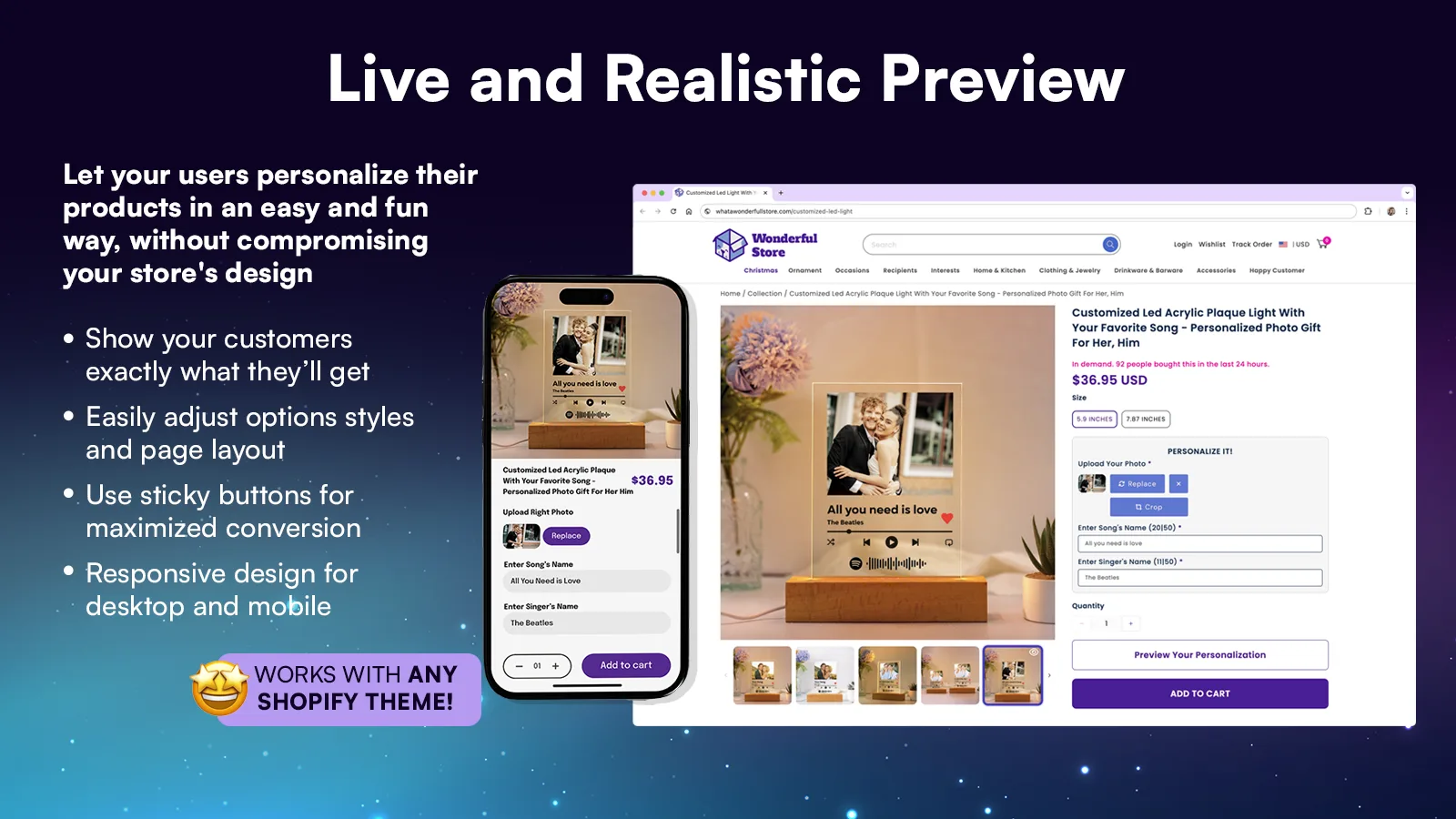
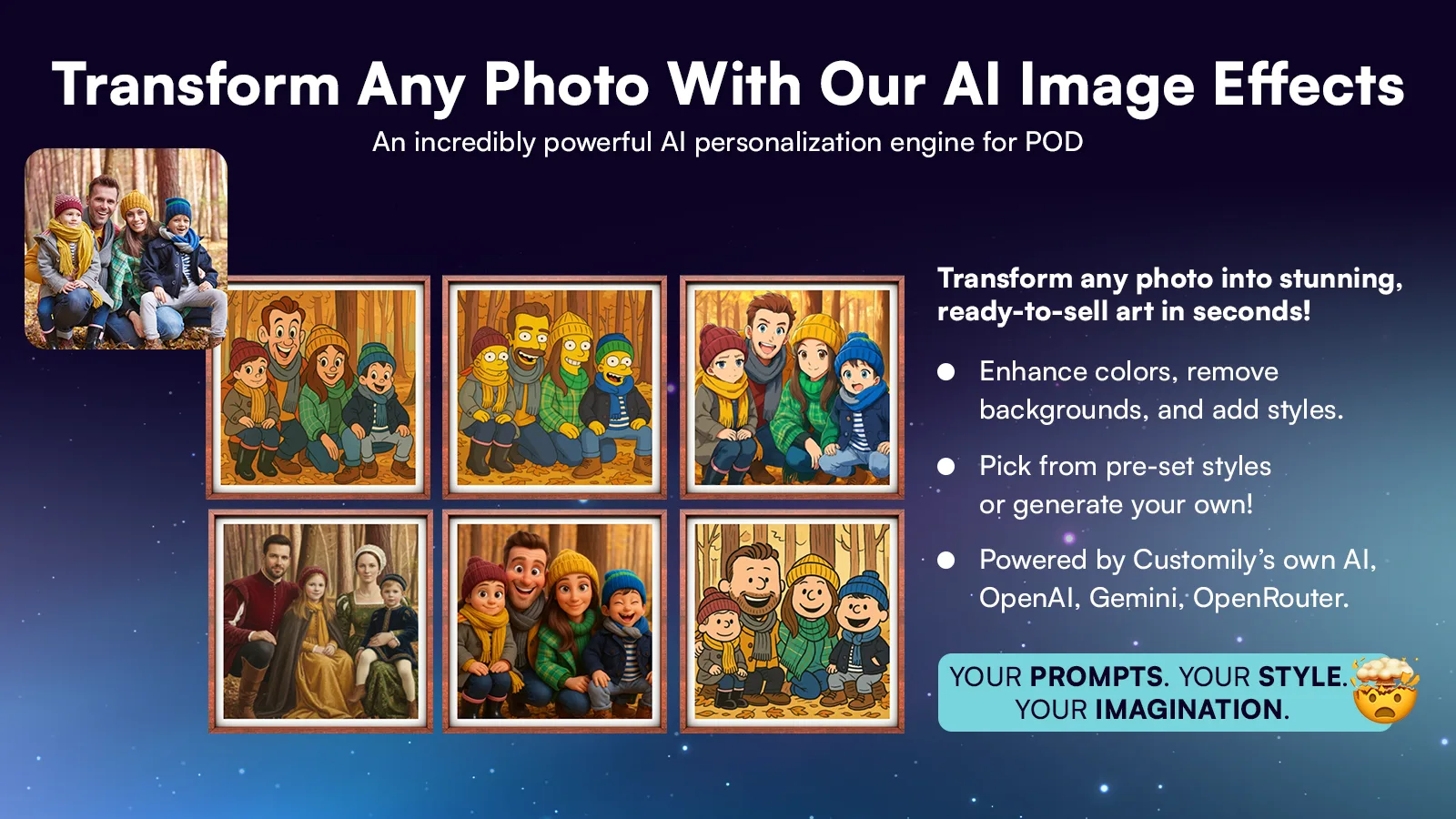
Public listing capture. Customily's Shopify App Store shows a live preview with photo and text inputs. Checked August 12, 2026. View the source listing.Public listing capture. Customily's listing presents AI image effects and styles as one part of its broader personalization toolkit. Checked August 12, 2026. View the source listing.
## Personalize.design is built around AI generation
Personalize.design starts with an AI Blueprint rather than a library of interchangeable design parts. AI is native to the workflow: the Blueprint defines the prompt, reference artwork, shopper inputs, background-removal steps, model settings, output rules, and how the artwork should fit the connected product. One Blueprint can be tested, reused, and attached to more than one product instead of rebuilding a layer system for every SKU.
That is a better match for products such as a pet portrait, family illustration, or photo-to-art gift. The shopper supplies the raw material. The workflow generates a new visual result, renders it on a supplier product mockup, and keeps the approved artwork attached to the order.
The prompting work is manageable because it can be supported by tools. The [AI design prompt generator](/tools/ai-design-prompt-generator/) can turn a product idea into a structured starting prompt, which the merchant then adapts and tests in the Blueprint. Merchant-controlled model choice, generation limits, and spend visibility keep the workflow practical for POD margins. Quality still improves when the merchant tests difficult photos, gives shoppers clear input instructions, and sets output rules.
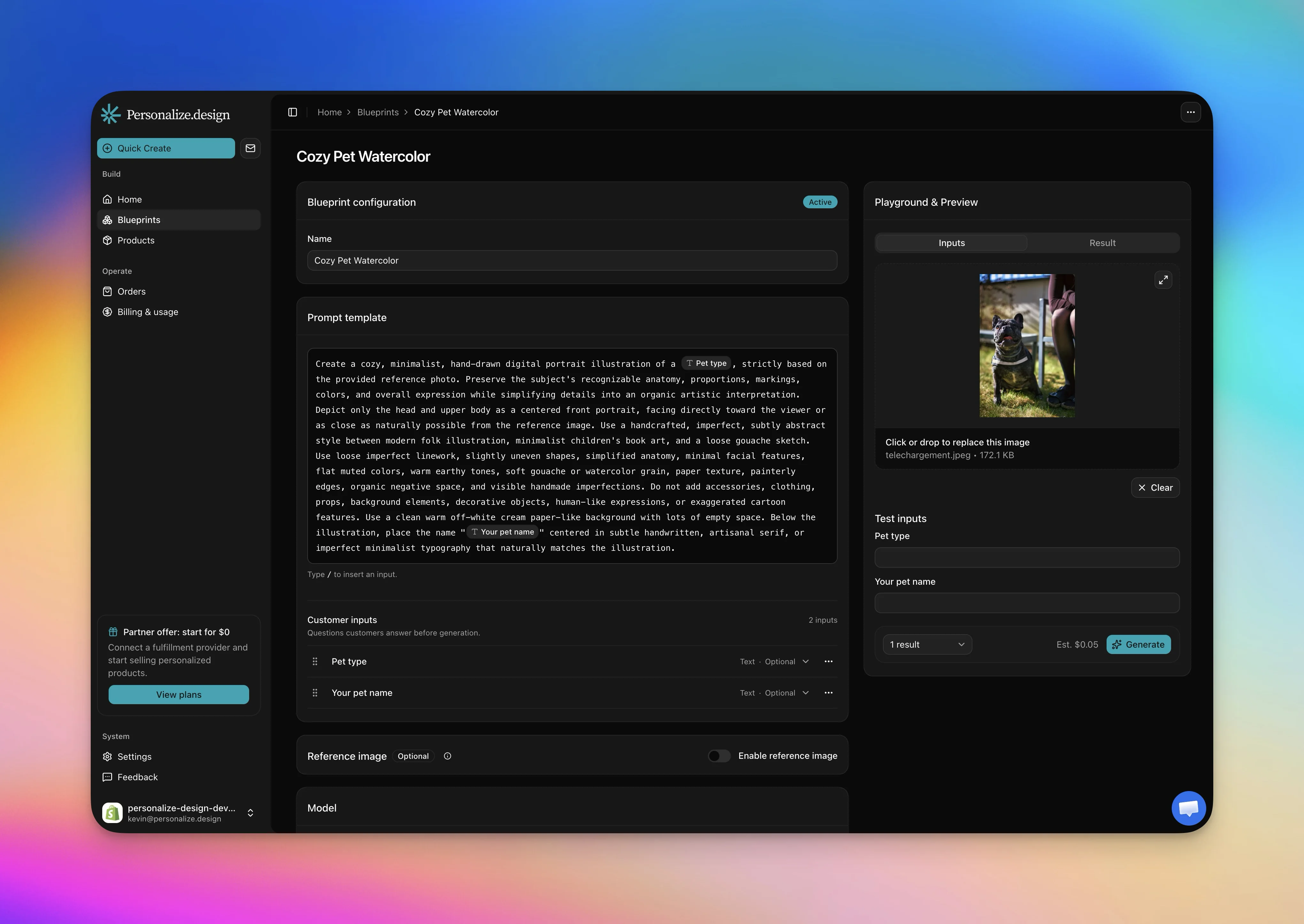
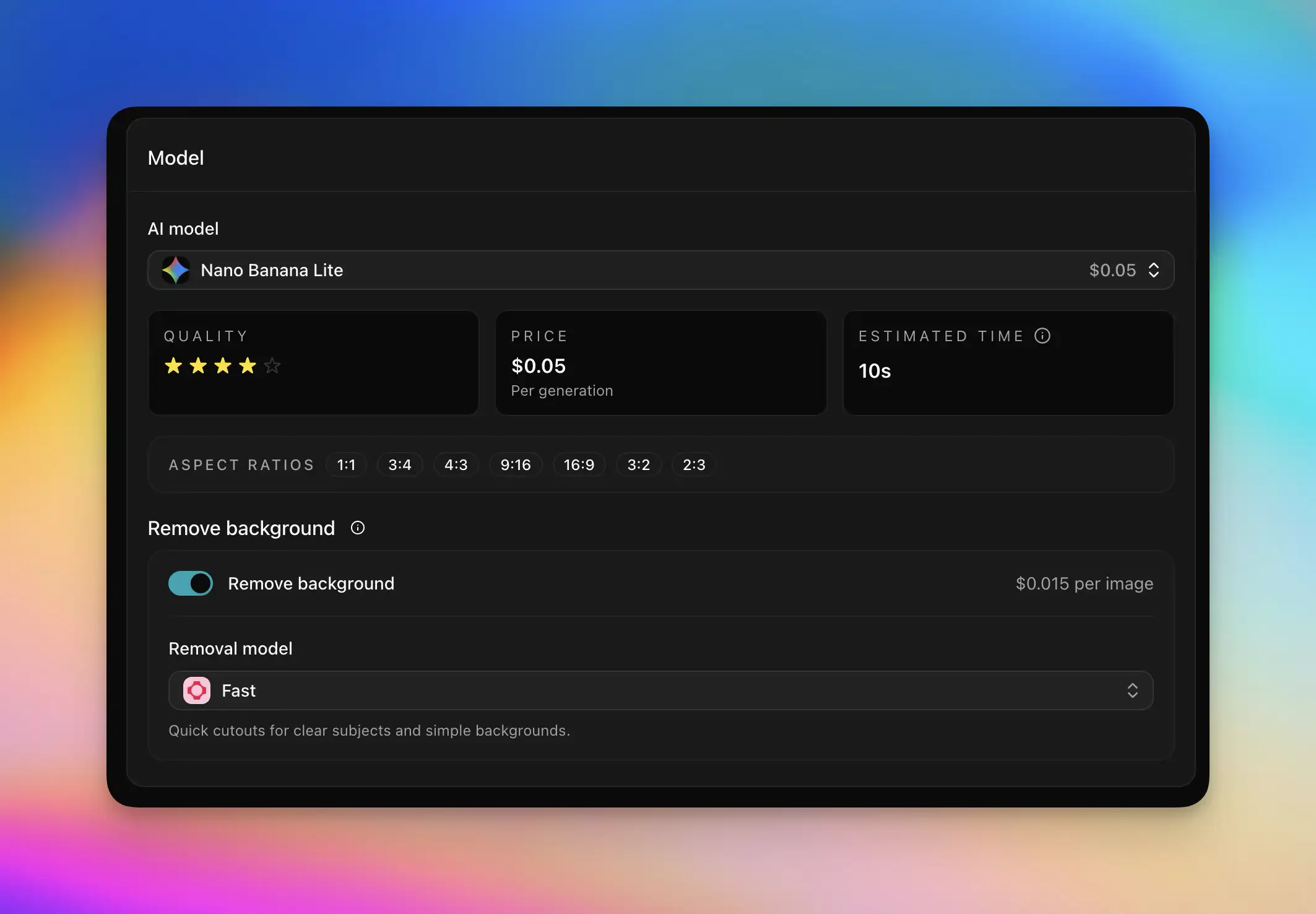
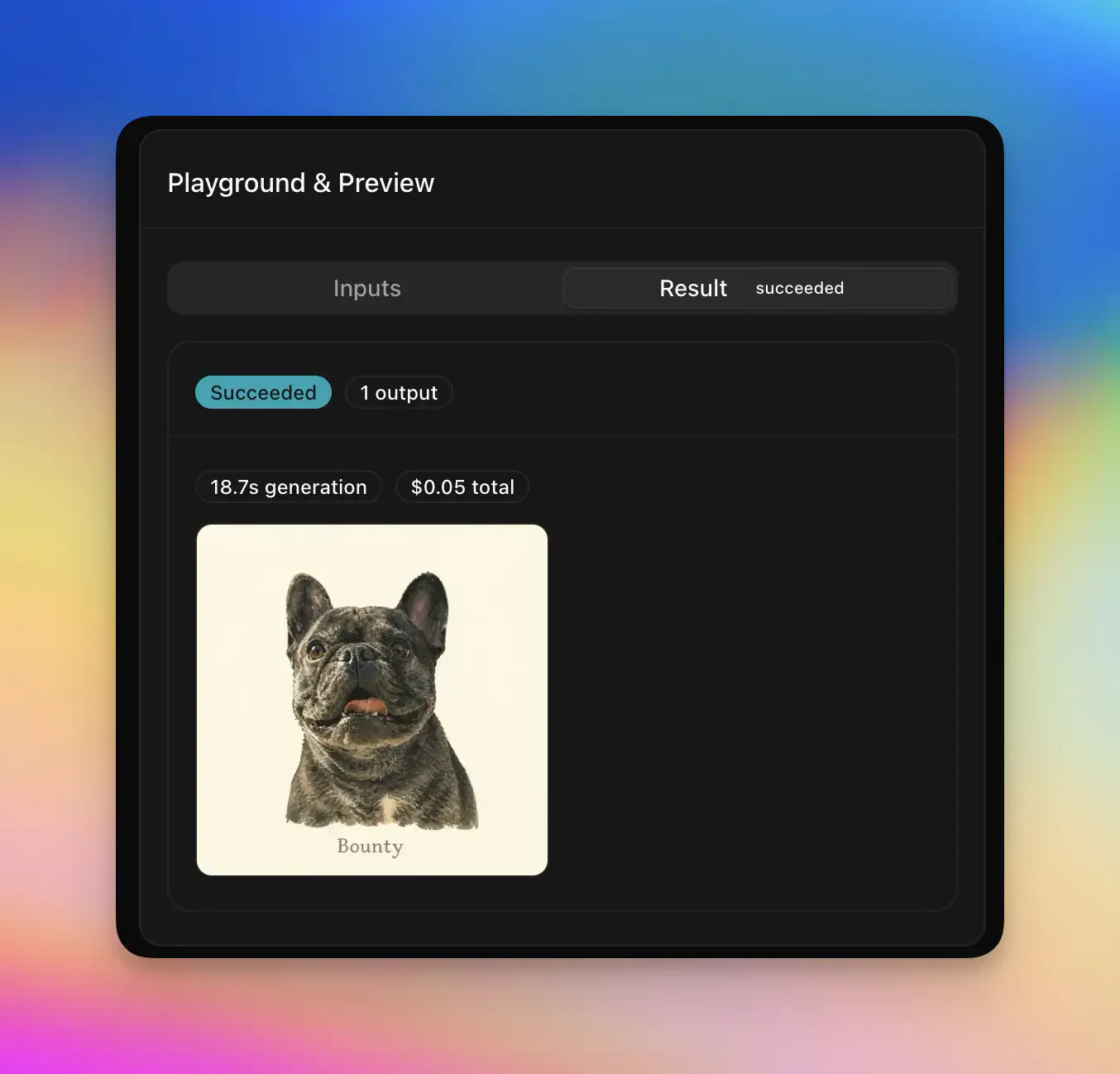
Product capture. An AI Blueprint brings the prompt template, customer inputs, reference image setting, and preview into one workflow. This is the configuration work behind a reusable AI-native product. Checked August 12, 2026. View the product listing.Product capture. Personalize.design includes model selection, aspect-ratio controls, and remove-background settings inside the generation workflow. These are tools for preparing artwork for a product, not a layer stack that the merchant must build for every visual element. Checked August 12, 2026. View the product listing.Product capture. The result view shows the generated artwork together with its generation status, time, and cost. The output is a new visual asset created from the shopper input, rather than a JPEG composite assembled from prepared layers. Checked August 12, 2026. View the product listing.Product example. An AI-native personalization workflow can support house portraits, pet artwork, custom apparel, mugs, and tote bags from a shopper photo or brief. The common output is new product artwork, not only a filter applied to an existing image. Checked August 12, 2026. View the product listing.
Customily uses AI as one set of capabilities inside a prepared product system. Personalize.design is built around AI generation from shopper input, with references, prompts, and output rules at the center of the product workflow.
## Fulfillment: automate the handoff or review before submission
Customily's [official Printify guide](https://help.customily.com/articles/8543285826-how-does-the-integration-with-printify-work) describes a specific sequence:
1. Publish a product in Customily using a Printify product as the base.
2. Receive the order in Shopify with the personalization data.
3. Wait for Customily to generate the print file, which the guide says usually takes around 30 minutes.
4. Send the order to Printify through the API.
5. Confirm the order in Printify, or configure Printify to approve orders automatically.
Customily gives merchants an automated Printify handoff with an approval state. That is useful when a store wants to review or automatically approve orders after the file is ready.
Personalize.design supports two fulfillment modes for Printful and Printify. With auto-submit enabled, validated orders move through the connected provider workflow without a manual approval step. With review before submit enabled, the order pauses in **Needs review** after the artwork and product mockup are ready. The merchant can inspect the customer input, current artwork, product mockup, print dimensions, and production details, download or replace the final asset, then click **Approve and submit**.
That gives the merchant control without turning every order into manual design work. Supplier, product, variant, and print-surface checks still happen before submission, and an order that needs attention can be corrected or retried instead of being sent blindly to production.
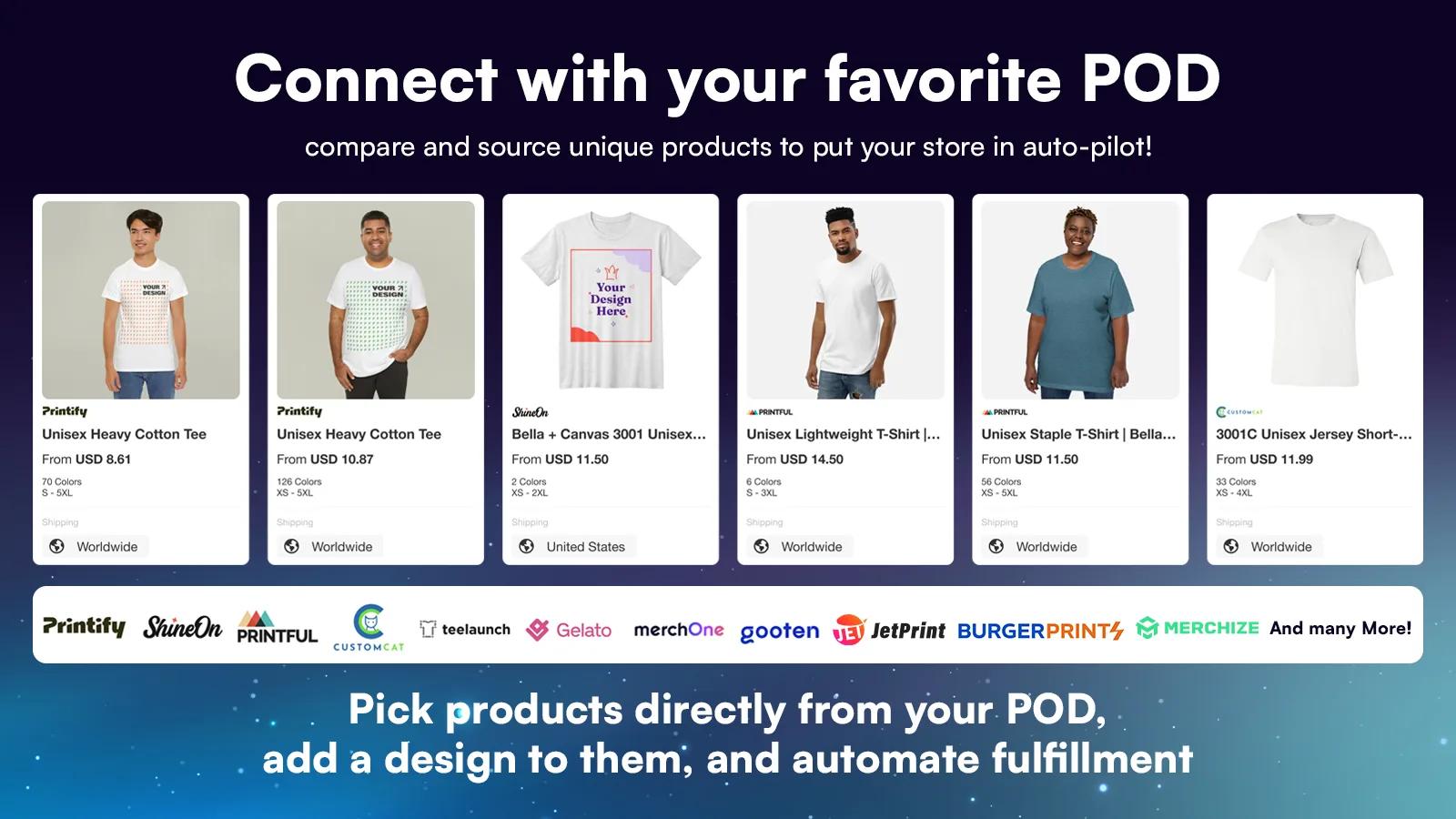
Public listing capture. Customily's App Store listing shows connections to POD providers. The Printify timing and approval steps come from Customily's help documentation, linked above. Checked August 12, 2026. View the source listing.
## Price is only one part of the comparison
Customily publishes a $49 monthly subscription per platform, then charges a fixed fee per unique personalized item sold. Its pricing tiers reset monthly. If one order contains five different personalized products, the pricing FAQ says each unique item can create a fee; five copies of the same personalization can count differently.
Personalize.design has a free Build plan for drafts and testing. Launch costs $29 per month or $290 per year. During the 14-day trial, the Launch subscription and $0.45 item fee are waived, while AI generation remains billed at cost from first use. After the trial, each personalized item sold adds $0.45, and generation spend still depends on how many previews, retries, and failed attempts occur.
Use the [personalized product margin calculator](/tools/personalized-product-margin-calculator/) to model both the expected month and a month with more retries. Include staff review time, reprints, supplier failures, and abandoned previews. A cheaper subscription does not automatically produce a cheaper order.
## Choose based on the product you are building
Choose Customily when your catalog depends on prepared visual elements, conditional options, many personalization types, multiple fulfillment providers, or products outside a pure photo-to-art workflow. Its strength is the control it gives merchants over a broad catalog of prepared products.
Choose Personalize.design when the generated artwork is the product. It is the AI-native option for a shopper who uploads a photo or brief, sees a real generated render before checkout, and has the result routed through Printful or Printify with either automatic submission or merchant approval before fulfillment.
The practical next step is to start with one representative product. Read the [guide to AI product personalization on Shopify](/guides/ai-product-personalizer-for-shopify/), use the [AI design prompt generator](/tools/ai-design-prompt-generator/) to prepare the first Blueprint, then [try Personalize.design on Shopify](https://apps.shopify.com/personalize-design-beta).
## Sources
- [Customily on the Shopify App Store](https://apps.shopify.com/customily-product-personalizer)
- [Customily pricing](https://www.customily.com/pricing)
- [Customily option sets](https://help.customily.com/articles/1529215350-understanding-how-option-sets-work)
- [Customily conditional logic](https://help.customily.com/articles/1560701035-using-conditional-logic-to-show-and-hide-options)
- [Customily Printify integration guide](https://help.customily.com/articles/8543285826-how-does-the-integration-with-printify-work)
- [Personalize.design on the Shopify App Store](https://apps.shopify.com/personalize-design-beta)
For adjacent workflows, compare this page with the [Teeinblue alternative](/alternatives/teeinblue-alternative/) and the broader [Shopify product personalizer comparison](/compare/best-shopify-product-personalizer-apps/).